

Executive Visibility: Why Being Seen Is Essential to Being Effective

Delivering results is no longer enough. The leaders who rise know how to make their leadership travel as far as their work.
Visibility used to take care of itself. Walk the halls, show up at town halls, travel to client sites. People noticed.
Today, it is different. Offices are more dispersed. Structures are more matrixed. Stakeholders are more distracted. Delivering results is not enough if no one sees you shaping them.
At the executive level, visibility is not about ego. It is about making sure your leadership travels as far as your work does.
One of my mentors at Microsoft had a phrase: publish or perish. He was not talking about academia. He meant that if you were not sharing your impact, connecting internally, and making yourself known, your work would quietly vanish. And so would your opportunities. At the time, I did not fully appreciate how true that was. I thought the work would speak for itself.
Later in my career, I learned the hard way. Results are necessary, but not sufficient. Visibility is not vanity. It is how leaders earn trust, shape narratives, and get invited into the rooms where strategy is made.
This brief unpacks what executive visibility really means. Why it matters, how to build it, and how to sustain it. You will find research-backed insights, real-world stories, and reflection questions designed to help you treat visibility not as a side task, but as a core leadership strategy.
The Executive Visibility Dilemma
Many leaders assume that if they deliver results, people will notice. But in reality, results rarely speak loudly enough, especially at the executive level.

Strong performance in a remote setting does not automatically travel to the people making decisions about your future.
Take remote and hybrid work. Those informal hallway moments are gone. You cannot rely on being seen at your desk or bumping into someone in the elevator. A Stanford field study found that remote workers were 50% less likely to be promoted, even though their performance was equal. It was not the work that held them back. It was visibility.
Or consider post-M&A integrations. The credibility and alliances you built in your old org do not automatically transfer to the new one. Power resets. Trust has to be rebuilt. Who would advocate for you in that reshuffle? If no one can answer that clearly, invisibility is a risk.
And in executive transitions, visibility equals legitimacy. A new CEO or senior leader who does not show up with presence, with voice, with connection risks being perceived as uncertain or disconnected.
Too often, visibility gets mistaken for noise or self-promotion. But at the executive level, it is something very different, and far more powerful.

What Executive Visibility Is (and Isn’t)
Executive visibility is not about shouting the loudest, clocking the most office hours, or promoting yourself for the sake of it. It is not noise. It is not vanity.
True visibility is about showing up with substance, aligning presence to strategy, earning credibility through contribution, and making sure your leadership is seen as clearly as your results.

Visibility isn’t volume. It’s showing up with substance where it matters most.
Take K. She was fully remote in a company that valued outcomes, and by every measure, she delivered. Her reviews were stellar. Her customers loved her. But she did not make time to travel in. She stayed off the radar of leaders who were not in her direct line of sight.
And when layoffs came, she was chosen.
The problem was not performance. Results were not enough. Decision-makers needed to see her.
Conferences as Visibility Catalysts
Conferences are not just networking events. They are visibility multipliers. In a world where in-person office time has diminished, they function as the new hallways, where credibility, connection, and recognition happen in concentrated bursts.

Conferences are the new hallways. The visibility happens between the sessions, not during them.
One client of mine, L, was asked by a new CEO to increase her visibility. The request sounded straightforward: travel more often. But with a small child at home and a partner who already traveled for work, it felt overwhelming. She did not want to be away just for the sake of being seen.
So she reframed the ask. She coordinated with others in her company so she was getting that personal connection with her team, and she decided to leverage industry conferences. By attending strategically, she not only showed up for her organization but also returned with insights, connections, and ideas that energized her and advanced the business. Her CEO praised her for the approach, and as an extrovert, she found the rhythm personally fulfilling. The bonus? Her partner got extra one-on-one time with their child.
Research backs this up. Abbott et al. in Science found that conferences are critical sites for knowledge sharing, collaboration, and recognition. The visibility you gain does not just happen in the room. It multiplies when you bring back insights that elevate your team and organization.
So the question becomes: am I treating conferences as errands to get through, or as catalysts that amplify both my visibility and my impact?
How You Get Executive Visibility
Visibility does not happen by accident. Especially in hybrid environments or post-M&A transitions, leaders have to create it. The most effective executives build visibility across four arenas: internal networks, external presence, digital platforms, and cross-functional leadership.

The fastest way to become visible is to step into a problem no one else has claimed.
One of the fastest ways I have seen leaders create visibility is by chairing a task force. At IBM, I saw firsthand how this played out. A leader noticed an organizational issue that no one owned, so she stepped up. She convened a cross-functional group, pulled people together to solve the problem, and eventually had the opportunity to present the work to senior leadership. That single act not only solved a real business pain point, it also put her in front of the right people, expanded her network across silos, and built credibility as someone who made things happen.
Herminia Ibarra’s research in Harvard Business Review confirms this. Leaders who cross boundaries gain disproportionate visibility, political capital, and insight into future opportunities. In other words, stepping outside your lane is one of the fastest ways to be seen as strategic.
The same applies in other arenas. Internal networking, sharing updates, connecting your work to the larger strategy. It all ensures results do not stay trapped in your team. External presence, speaking at panels, attending client events, makes your leadership visible beyond company walls. Digital presence, from publishing on LinkedIn to podcast appearances, extends your credibility into the spaces where decisions are actually made.
Who outside of my immediate function knows the value I’m creating?
How You Keep Executive Visibility
Visibility is not a one-time event. It compounds when it is sustained with intention. Leaders who treat it as episodic, posting once a year, attending a single conference, remain largely invisible. True visibility requires rhythm.

Visibility compounds only when it becomes a rhythm. Episodic effort fades quickly.
I once worked with an executive who resisted conferences. She dismissed them as fluff and preferred to keep her head down in the work. But after a nudge from her CEO, she decided to give them another try. This time, she approached them differently. She treated them as strategic classrooms, not just networking obligations. She prepared questions in advance, sought out specific peers and partners, and took notes to bring back to her team.
What changed was not just her visibility in the industry. It was her visibility inside her company. By returning with insights, she positioned herself as both learner and teacher, expanding her reputation as someone who saw around corners. The consistency of this practice, showing up externally, then multiplying the value internally, made her visibility sustainable.
Weber Shandwick’s research shows that 44% of a company’s market value is attributable to the CEO’s reputation. And while not everyone is a CEO, the principle holds. Reputations are not built in one splashy moment. They are the accumulation of steady presence over time.
So the question is: do I have a cadence of visibility that compounds, or am I only visible in bursts?
How To Measure Executive Visibility
Visibility can feel intangible, but it is measurable. The simplest way to gauge it is by asking: who sees my impact, and who is inviting me in?

The right measure of visibility is not how busy you are. It is who is paying attention.
Take P, a senior executive who held one of the top seats in his company. Despite his role, he struggled to get meaningful face time with the CEO and the board. His calendar was full, sixteen-hour days packed with back-to-back meetings, but the right audiences were not seeing him. He knew that without deliberate visibility at the top, his influence and future opportunities would stall.
So he started creating those opportunities. He scheduled informal coffees with key stakeholders, volunteered to chair a cross-functional task force, and sought out moments to present insights that mattered strategically. Over time, his visibility was not just measured by how busy he was. It was measured by who was paying attention.
This is the essence of measuring visibility. It is not about counting hours in meetings or posts on LinkedIn. It is about whether the right people, peers, boards, investors, industry leaders, are seeing your leadership in action. Research backs this up. Ronald Burt’s work shows that promotions and pay disproportionately go to leaders who bridge networks and gain visibility across boundaries.
So the question becomes: am I visible to the people who matter most to my leadership future, or am I only busy in places where visibility does not travel?
Common Pitfalls and How to Avoid Them
Even seasoned executives fall into visibility traps. Here are some of the most common, and how to avoid them.
Pitfall 1: Visibility Without Substance
The trap: chasing exposure without offering insight. Leaders flood LinkedIn with surface-level posts or show up to every meeting, but without adding value. It is noise, not influence. The fix? Anchor every visibility effort in data, diagnosis, or perspective that moves the conversation forward.
Pitfall 2: Invisibility Through Silence
One of my clients, R, was the first to step in when issues arose. She dropped what she was doing, supported her peers, and played the role of team player. But in meetings, especially the ones her boss convened, she often held back. Unless she was the subject-matter expert, she hesitated to speak up.

Silence in the room is not neutral. It tells people you are not yet ready to be seen.
In her review, the feedback was clear. We want to hear more from you. We need your voice in the room. Her expertise was valued, but her silence made her less visible.
This is a common trap. Many leaders wait until they have the perfect answer or unique expertise before contributing. But visibility is not about perfection. It is about consistent presence. Speak up with a perspective, a question, or a connection. Influence grows not from flawless input, but from showing you are engaged and willing to shape the conversation.
Pitfall 3: Overexposure Without Substance
The opposite problem: executives who try to be everywhere. They show up in every meeting, post constantly, or push themselves into every conversation. But audiences fatigue quickly, and credibility erodes. The fix is cadence: showing up consistently in front of the people who matter. Visibility compounds when it is paced.
Pitfall 4: Crisis-Only Contributions
Some leaders shine in emergencies but fade when things stabilize. The result? Teams and boards question their steadiness. True visibility is not episodic heroics. It is steady leadership in the everyday. Try this: make your smaller, everyday contributions visible, so you are not only associated with fire drills.
Pitfall 5: Proximity Bias Blind Spot
Remote and hybrid leaders sometimes assume that strong results will carry the same weight as they would if they were more visible in the office. But decision-makers often still equate physical presence with impact. And if you are not deliberate about making your contributions visible, you risk being overlooked.
That is the danger of proximity bias. The fix? Counteract the bias. Share updates that circulate beyond your immediate team. Use artifacts (memos, presentations, thought leadership, virtual coffees, Slack channels, regular one-on-ones with peers, reaching out to your internal network to grow and expand and connect with people) that travel across locations. Make sure your leadership is visible even when you are not in the room.
Pitfall 6: One-Direction Visibility
Some executives concentrate their visibility in only one direction. They are deeply known and trusted by their teams, but invisible to peers and senior leaders. Or the reverse: they spend so much time managing up that their direct reports feel overlooked.

Leadership requires visibility in three directions. Up for credibility. Across for alignment. Down for trust.
Either way, the imbalance is costly. Leadership requires visibility in multiple directions. Down to build trust, across to build alignment, and up to build credibility. Over-focusing on one lane leaves blind spots in the others.
The fix? Audit your visibility. Ask: who sees me at my best? Who does not? Then design touchpoints that balance up, down, and across. Visibility compounds when it travels through the whole system, not just one level of it.
The through-line in all of this? Visibility is not about being everywhere or saying everything. It is about being seen in the right ways, in the right rooms, by the right people.
The Visibility Portfolio (VAL Model)
Executives often treat visibility like a side effect. It happens if it happens. But the leaders who sustain influence see visibility as a portfolio of assets, something to be balanced, invested in, and evaluated over time.
I learned this lesson firsthand at Microsoft. Earlier in my career, I assumed that focusing on customers and partners was enough. I poured energy into my regional partner and counterpart relationships, but neglected internal visibility, sharing less with peers, not spending enough time with mentors, and not promoting my work inside the company. When my team hit an ambitious five-year goal in just 18 months, the achievement was real. But when the role ended, my options were narrower than they should have been. I had built credibility outward, but not enough inside. My portfolio was out of balance.
That is the risk of leaning too heavily on one channel of visibility. Which is why I now think of visibility through the VAL Model:
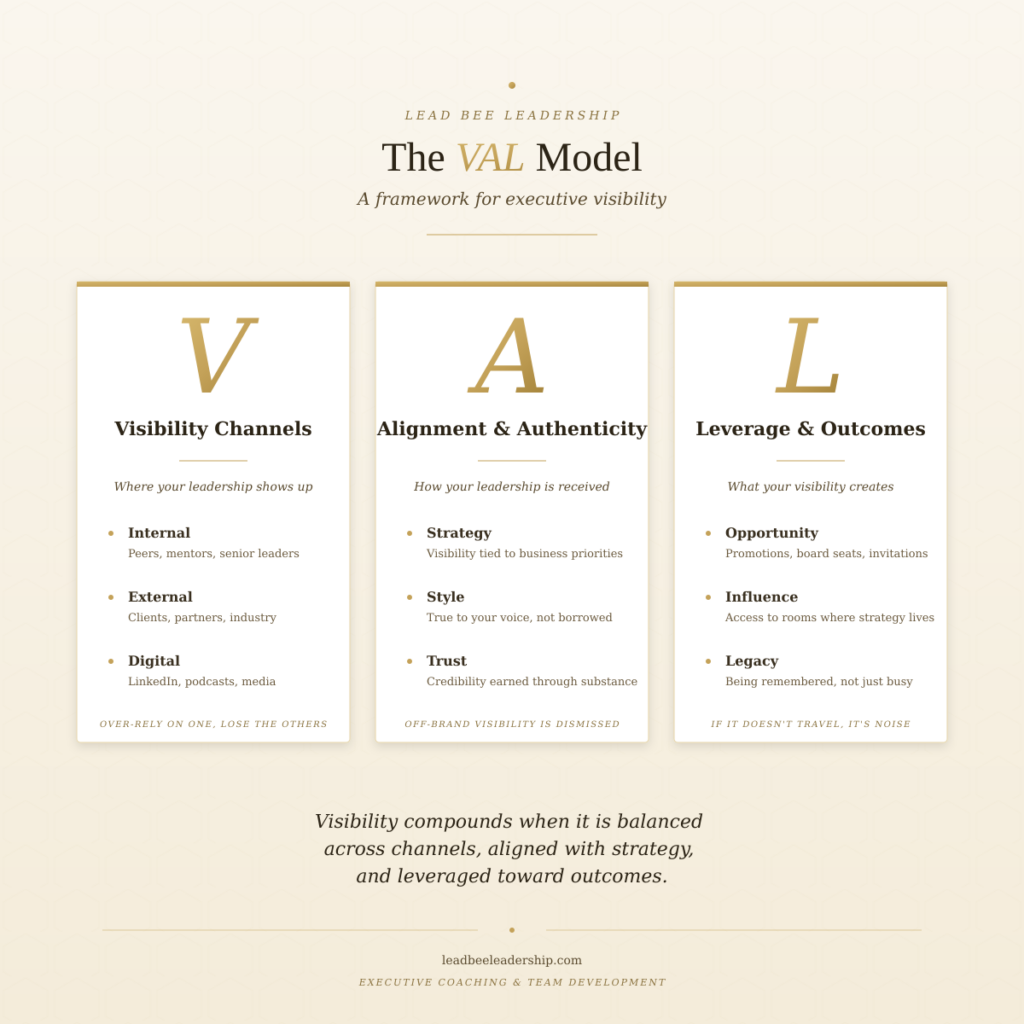
V = Visibility Channels
Internal (peers, mentors, bosses). External (clients, partners, regulators, industry peers). Digital (LinkedIn, podcasts, articles, media). Leaders need all three. Over-relying on one leaves blind spots.
A = Alignment and Authenticity
Visibility only builds credibility if it aligns with both business strategy and your authentic leadership style. A polished LinkedIn presence that feels off-brand, or a conference appearance disconnected from company priorities, can backfire.
Research from Edelman and LinkedIn backs this up. 73% of decision-makers say thought leadership is more trustworthy than marketing materials. In other words, when visibility feels authentic and relevant, it earns confidence. When it does not, it gets dismissed.
L = Leverage and Outcomes
Visibility is not just about being seen. It is about what that visibility creates. Promotions, invitations, commercial opportunities, board access, investor trust. If visibility is not turning into outcomes, it is noise.
The real question is not whether you are visible. It is whether your visibility is balanced across channels, aligned with strategy, authentic to your style, and leveraged toward meaningful outcomes.
Practical Strategies (Playbook)
Visibility becomes sustainable when it is built into the rhythm of your leadership. Here are practical moves I have seen executives use to expand and sustain visibility without adding unnecessary noise.

Visibility doesn’t require heroic effort. It requires steady presence.
Write a monthly narrative memo. Share a short update that connects your team’s work to the company strategy. Make it easy for peers and senior leaders to see the value you are creating.
Publish externally or speak once per quarter. Pick a cadence you can keep. A panel, a podcast, a LinkedIn article. The goal is not volume. It is consistency.
Develop a conference ROI plan. Before you go, decide who you want to meet and what insight you want to bring back. During, ask a thoughtful question in a plenary. After, share your takeaways in a memo or post. This turns a trip into a visibility multiplier.
Chair one cross-functional initiative per year. Step into a problem no one owns. Convene the group. Lead the solution. These are visibility accelerators because they expand your network and demonstrate leadership across silos.
Schedule micro touchpoints with senior stakeholders. Do not wait for performance reviews. A 15-minute coffee, a quick debrief after a board meeting, or a note sharing an industry trend can keep you visible in meaningful ways.
The key is rhythm. Monthly, quarterly, annually. Visibility does not require heroic effort. It requires steady presence.
So ask yourself: which of these practices can I commit to in the next 90 days to make my leadership more visible?

Visibility isn’t ego. It’s leadership in action.
It is what turns performance into recognition. Recognition into opportunity. And opportunity into lasting influence.
At the executive level, doing the work is no longer enough. The leaders who rise are the ones who know how to show the work in ways that are authentic, strategic, and sustainable.
The truth is, visibility does not look the same for everyone. For some leaders, it is about strengthening board presence. For others, it is about building digital credibility or creating a rhythm of influence across peers and partners. The most effective approach is always individualized.
That is where coaching comes in.
Ready to Expand Your Visibility?

Visibility is not a performance. It is a practice. And the right coach makes that practice stick.
If you are ready to expand your visibility, Executive Coaching can help leaders like you:
Because visibility is not just about being seen. It is about being remembered.
Book a call today to design your personalized strategy for executive visibility and lead with greater clarity, confidence, and impact.
Loved our blog post about the leadership development stages? Then check out these related articles…

The Link Between Leadership And Engagement

Rethinking Imposter Syndrome (And How To Overcome It!)

Conflict In Leadership: How To Resolve Clashes Among Team Members
The average American professional attends 60 meetings per month. Let’s make sure they help us move work forward, connect with colleagues, and find innovative solutions. Inside this guide, you’ll learn how to plan and execute meetings that accomplish what you set out to do.
Download our guide and create a bigger impact with interviews that can become a driver of change.
Connect & Coordinate
Get Our Free Guide To Effective Meetings:
